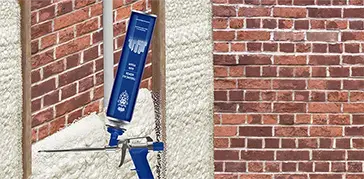
Gun-applied roofing foam
Gun-applied roofing foam is a polyurethane-based filling material used in roofing applications for gap filling, sealing, and strengthening thermal insulation. It is an ideal solution for sealing gaps in attics, under tiles, at roof joints, and around pipe penetrations. Its ability to be applied with a gun for controlled application provides a significant advantage, especially in hard-to-reach areas.
Roof areas are one of the areas in a building where the most energy loss occurs and which are most exposed to external factors. Therefore, it is very important that the products used in roof insulation are durable, long-lasting, and high-performance. Gun-applied roofing foam is a material developed to meet these requirements.
What is Gun-Applied Roofing Foam?
Gun-applied roofing foam is a single-component polyurethane product that expands and hardens upon contact with moisture. It fills gaps of varying sizes in roof areas, prevents air leaks, and minimizes water penetration. Thanks to its gun-applied design, even the narrowest spaces in the attic can be easily filled.
Thanks to its expansion properties, it completely covers the area where it is applied, creating a strong insulation surface. After hardening, its mechanical strength increases and it retains its structure for many years.
Why are spray-applied foam devices used in roofing areas?
Roof areas are critical spaces where different materials meet and where the most energy loss occurs. Therefore, it is necessary to completely fill the gaps and ensure watertightness. Gun-applied roofing foam is frequently preferred in roofing applications because it offers the following advantages:
- It is easy to apply to hard-to-reach areas.
- It completely fills the gaps, preventing air leaks.
- It minimizes water and wind ingress.
- It improves thermal insulation performance.
- The gun allows for controlled application.
Areas of Application
Gun-applied roofing foam can be safely used in many parts of roofing applications. It is particularly common in the following areas:
- Filling attic spaces
- Gaps and joints under the tiles
- Roof-wall junctions
- Chimney edges and chimney bases
- Air conditioning, antenna, pipe penetrations
- Closing the gaps under the trapezoidal roof.
- Preventing sound and heat leaks in the attic.
Pre-Application Preparation
Preparation is crucial for a successful roofing foam application. The following steps must be carefully followed:
- Surfaces must be clean, dry, and dust-free.
- The surface should be slightly moistened if necessary. Moisture ensures healthy expansion of the foam.
- Safety precautions must be taken in the roof area. The ground should be checked for the risk of slipping.
- Ensure the gun is in working order and check the adjustment screw.
How to Apply Roofing Foam with a Spray Gun?
There are some technical steps that need to be considered during application. These steps ensure a more robust and longer-lasting insulation:
- Insert the foam tube vertically into the gun.
- Shake the tube to ensure the contents are homogeneous.
- Instead of filling the gaps completely, fill them only halfway; the foam will expand to cover the area.
- In windy areas, application should be done quickly and the foam should be protected.
- Do not apply pressure to the treated area until the skin is fully hardened.
Expansion and Hardening Period
Gun-applied roofing foam expands rapidly depending on humidity and temperature. Initial expansion is observed within minutes, while full hardening may take several hours. The hardened foam can be easily cut and is suitable for coating processes.
When applying coatings to roof areas, it is important to remember that air temperature and ambient humidity can affect application performance.
Its Role in Heat and Sound Insulation
Attics are one of the areas in a building where heat loss is highest. Therefore, attic spaces should be properly filled and insulated. Gun-applied roofing foam enhances both heat and sound insulation in these areas, improving living comfort.
It reduces heat loss in winter and prevents hot air from entering the interior in summer. This contributes to energy savings.
Sealing Performance
Water, moisture, and wind ingress in roof areas can cause serious problems. Even small gaps, especially at joints, can lead to significant damage over time. Gun-applied roofing foam provides complete sealing on the surfaces where it is applied, increasing watertightness and preventing external elements from reaching the interior.
Common Mistakes in Foam Application
Certain mistakes made during application can reduce the foam's performance. These mistakes include:
- Overfilling of voids and failure to account for expansion.
- Failure to check surface moisture before application.
- Direct exposure of foam to UV light
- Incorrect adjustment of the gun
- Uncontrolled application in strong winds
Durability and Longevity
Hardened gun-applied roofing foam maintains its durability for many years. Thanks to its high adhesive strength and mechanical resistance, it does not lose its shape over time. It is resistant to humidity and temperature changes. The only point to note is that the foam must be applied in areas that will be exposed to sunlight for extended periods.
Recommendations for Professional Application
To achieve more efficient and professional results, some key points should be considered:
- The expansion allowance should be calculated before application.
- A gun nozzle extension attachment can be used to reach narrow spaces in the attic.
- In areas with high wind penetration, foam should be applied quickly.
- The foam must be allowed to harden completely after application.
- If the foam is to remain on the exterior surface, it must be protected with a UV-resistant coating.
Conclusion
Gun-applied roofing foam is a highly effective product used in roofing applications for gap filling, insulation, and sealing. Its controlled application and high expansion performance make it a popular choice for roofing areas. When applied correctly, it provides both energy savings and increases structural safety.
The information in this text may vary from time to time depending on the manufacturer. Always check the product label.